


2026 Bank of Utah Championship


Introduction
After a week of Presidents Cup pageantry at Medinah, the PGA Tour trades red, white and blue for black lava as the FedExCup Fall makes its third stop at Black Desert Resort in Ivins, Utah. The course is the real headliner, Tom Weiskopf's final design, blasted out of an ancient lava field at 3,100 feet of elevation, where a drive that strays past the turf is often a drive you never see again. Defending champion Michael Brennan returns as a two-time Tour winner and a career-high No. 32 in the world after turning last year's breakthrough here into a Wyndham Championship title. Expect low scores, expect a few blow-up holes when the lava gets involved, and I expect the winner to be the player who balances aggression with restraint better than anyone else.
Course Breakdown
Black Desert Resort plays to a par of 71 and stretches to 7,421 yards, with three par 5s, four par 3s and eleven par 4s. It was Weiskopf's last design, completed with partner Phil Smith, who has described dynamiting every inch of the routing out of the lava flow before capping it with three feet of sand. The lava lines nearly every hole, and Utah native Zac Blair has called it a "do or die" hazard because balls in the rocks are rarely found. The property is wide by design, and over the first two years it produced the highest driving accuracy on Tour at roughly 83 percent, making it the easiest course off the tee. The two drivable par 4s, the 320-yard fifth and the 322-yard 14th, are where the risk and reward is greatest, since the fifth has lava behind its green and the 14th sits in a bowl behind a wall of black rock. Off the tee, this course rewards a driver-heavy player who can put the ball in play and use the thin air to take on the short holes.
Approach play is where the round is decided. Roughly 61 percent of approach shots in the first two years came from 125 to 200 yards, so mid-iron precision matters more than wedge play. The par 3s run from 151 to 202 yards, including the third, a shot of about 200 yards to a green with a bunker cut into its middle as an homage to Riviera's sixth, and the 17th, a 151-yard spin-off of Royal Troon's Postage Stamp with three bunkers and runoffs on every side. The greens average about 7,000 square feet, run near 12 on the Stimpmeter and contain subtle pockets that Nick Taylor said make reads tricky. Water guards two of the longest par 4s, the 11th and 13th, which puts extra pressure on long irons. Miss in the wrong quadrant and the numbers show how hard the short game gets, with only about a 55 percent scrambling rate from short-grass lies.
Scoring chances are plentiful, starting with three par 5s of roughly 587 to 595 yards that the altitude brings within reach for anyone who finds the fairway. The semi-blind seventh winds through a maze of black rock, and the dogleg-left 18th closes the round with a green inspired by Augusta's fifth. Add the two drivable par 4s, and it is no surprise the course has averaged about 1.56 strokes under par per round, ranking ninth easiest on Tour, with Adam Svensson opening the 2024 event with a field-low 60. The equalizers are the lava, wind that can reach 40 mph on the property, and the greens, where the three-putt rate of 3.7 percent beats the Tour average of 2.8 percent. Ultimately, Black Desert rewards a long, accurate driver who hits mid-irons close, avoids the lava when it matters, and rolls the ball well on big, undulating bentgrass greens.
Field Breakdown
This is a 120-player field that is short on marquee power but not on storylines. Defending champion Michael Brennan is the highest-ranked player at No. 32 in the world, fresh off a Wyndham Championship victory and a T10 at the BMW Championship in his last start. Maverick McNealy at No. 48 is the only other player inside the world top 50, which shows how thin the top of this field is. Name recognition comes from Utah native Tony Finau, who will have the crowd behind him, along with Max Homa, Billy Horschel and 2009 U.S. Open champion Lucas Glover. Beyond Brennan and McNealy there is no true elite tier, so course fit and current form will matter more than star power.
The second tier is built around players with Black Desert credentials. Matt McCarty won the inaugural edition at 23 under, Rico Hoey was the runner-up last year, and Stephan Jaeger was the runner-up in 2024, so all three have shown they can go low here. Nick Taylor played in the inaugural event and knows the routing, and Denny McCarthy's putting matters on greens this tricky. Length is also a factor, and recent college stars such as Luke Clanton, Jackson Koivun, Gordon Sargent and Nick Dunlap should get a boost from the thin air on the par 5s and drivable par 4s. Christiaan Bezuidenhout, Ben James, Marco Penge, Eric Cole, Max Greyserman, Matt Wallace and Davis Thompson round out the names the tournament itself highlighted.
The depth of the field is a mix of veterans and international players, including Chris Kirk, Emiliano Grillo, Rasmus Højgaard, Haotong Li and Takumi Kanaya, plus a Utah contingent that includes Zac Blair and Patrick Fishburn. There are no LIV players this week, and the FedExCup Fall points at stake will decide 2027 playing status for many of the players on the bubble. What separates the realistic winners from the rest of this field comes down to who can drive it accurately without giving up distance, hit mid-irons to the correct quadrants of these big greens, and putt well on bentgrass, because those three skills line up with what this course has demanded in its first two editions.
Tournament History
Black Desert has only hosted the event twice, but the sample is consistent. The course is an easy-scoring resort layout, averaging 69.061 in 2024, which made it the second-easiest full-field par 71 that season, and going under par by about 1.56 strokes per round across two years. Matt McCarty won the inaugural event at 23 under, three clear of Stephan Jaeger, after Adam Svensson opened with a field-low 60. Michael Brennan matched that pace last year at 22 under, four clear of Rico Hoey, in his first start as a professional, and he led the field in Strokes Gained: Off the Tee. With the 2026 greens getting faster, per players, and a field with less star power, I would not be surprised to see another winning score in the low 20s under par, though wind can change that quickly.
Below is a look at the past 2 champions, including their winning score relative to par:
2025 - Michael Brennan (-22)
2024 - Matt McCarty (-23)
Outright Betting Selections
Ben James +2000
My model has Ben James ranked second in this week's field, and at +2000 I'm happy to back the player who has been the most convincing tee to green force in this group over the last two months. The case starts with closing power. He followed a solo third at the Wyndham Championship with a runner-up finish at the Biltmore Championship Asheville, and both weeks ended with a final round 61. Black Desert is a resort layout that pays long, accurate drivers who hit mid-irons close, and that is exactly the game James has been showing. A rookie at this price makes me nervous only until I look at how close he has been in back-to-back starts.
James turned pro in June and led the RBC Canadian Open through 36 holes, though a third-round 78 dropped him to a tie for 54th. Since then he posted a tie for 23rd at the U.S. Open, a tie for 15th at the ISCO Championship, a tie for fourth at the Corales Puntacana Championship, and a tie for 38th at the Rocket Classic, with a missed cut at the 3M Open in between. He has no history at Black Desert, but Puntacana is a resort course where birdies come in bunches, and Biltmore was a par 71 where he reached 24 under. That is the kind of scoring environment this event tends to produce.
James ranks well above the PGA Tour average in strokes gained total this season, and the engine is his iron play, which is his best category. He is above average off the tee with plenty of length, and that combination fits a course where most approaches come from 125 to 200 yards and the par 5s are reachable in the thin air. His putting is also above average, which matters on Black Desert's large, subtle greens. The soft spot is around the green, where he is only roughly average, and that is worth noting on a course where scrambling from short grass has been hard.
The case for James comes down to elite iron play, a driver that helps on the par 5s, and a run of finishes that says he can hold up on Sunday. The risk is inexperience. He has a handful of stumbles on his record, including that 78 in Canada and a four-bogey stretch in the third round at Wyndham, and he is now a name at the top of the market. I'm on him regardless.
2026 PGA Tour Strokes Gained Rankings:
Total: N/A
Off-the-Tee: N/A
Approach: N/A
Around the Green: N/A
Putting: N/A
Marco Penge +2800
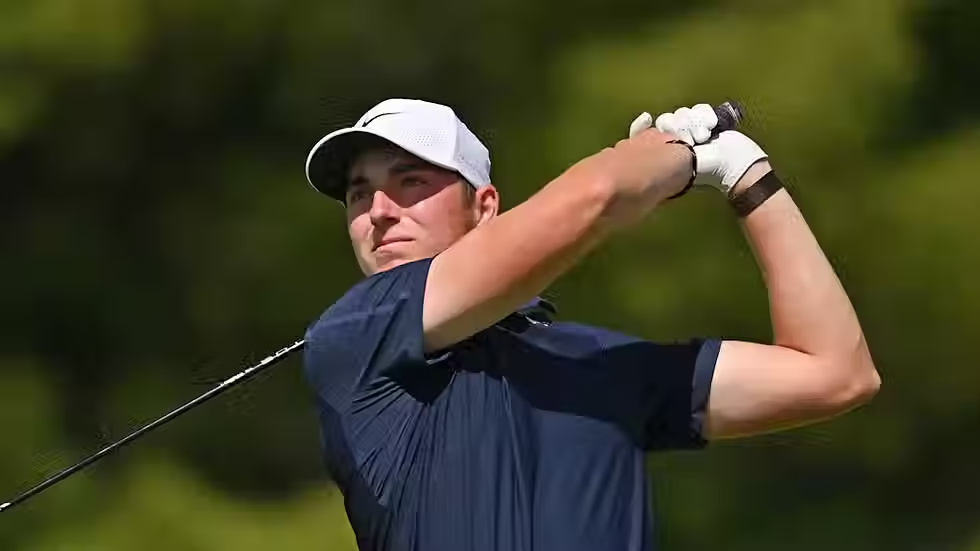
My model has Marco Penge ranked seventh in this week's field, and at +2800 I like the ceiling more than the price suggests. The reason is length. Penge is one of the best drivers on Tour, and a course at 3,100 feet with wide playing corridors, three reachable par 5s and two drivable par 4s is built for exactly that. This has been a rough year for him, but his form has turned in the right direction.
Penge described this season as a nightmare, complicated by family and medical setbacks, and his best PGA Tour result remains a tie for fourth at the Valspar Championship. Since then he has a tie for 18th at The Open at Royal Birkdale, a tie for 45th at the Rocket Classic, and a tie for 38th at the Wyndham Championship. He then played two DP World Tour events, finishing tied for sixth at the British Masters and tied for 18th at the European Masters, before a tie for 10th at the Biltmore Championship Asheville at 19 under. He has never played this tournament, but Biltmore is the closest comparison: a low-scoring par 71 where driving length was rewarded.
His strokes gained profile is lopsided in a way that fits this week. Off the tee he ranks among the best on Tour, and he is among the longest hitters. Approach play is below average, putting sits toward the bottom of the Tour, and around the green he is below average, though that has improved in his recent starts. The driver gives him a shorter club into greens and a real chance at eagle on the par 5s, while the putter is the obvious threat on a course that has played as one of the tougher putting tests.
Penge is a ceiling play. If the driver is on and the putter is even average, he can go low on a course that gives away scoring to long hitters. The risk is the flat stick and an iron game that has not consistently held up.
2026 PGA Tour Strokes Gained Rankings:
Total: 101st
Off-the-Tee: 10th
Approach: 125th
Around the Green: 102nd
Putting: 135th

Jackson Suber +3600
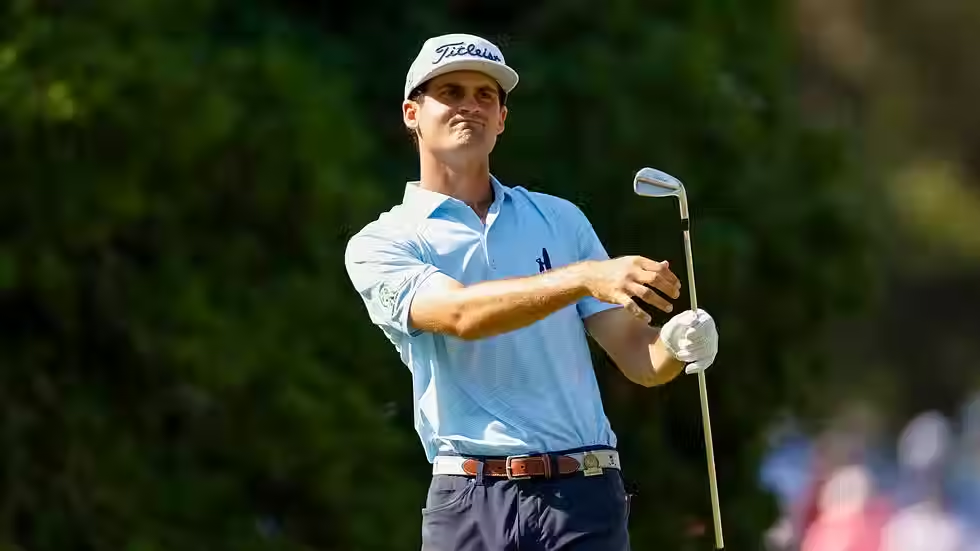
My model has Jackson Suber ranked fourth in this week's field, and at +3600 that gap between my number and the market is the whole reason I'm here. Black Desert is an iron player's course, with about six in ten approaches coming from 125 to 200 yards, and Suber ranks among the best in that range. He also has course history, having tied for 15th here last year at 13 under. A player who fits the course and has already scored well on it is hard to ignore at this price.
His recent form is uneven but has real highs. He tied for 15th at the Biltmore Championship Asheville at 18 under, finished 22nd at the Wyndham Championship, and placed 50th at the Rocket Classic after missing the cut at the 3M Open. Before that he led after the first round of The Open at Royal Birkdale and finished tied for 28th, and he finished sixth at the John Deere Classic. Earlier in the year he tied for fourth at the RBC Canadian Open and finished solo fourth at the CJ Cup Byron Nelson at 23 under, so he has shown he can go very low. Last year at Black Desert he opened 66 and 67 before a 70 and a 68.
Suber ranks highly in strokes gained approach and near the top in greens in regulation, exactly the skill a course with big greens and a lot of mid-iron shots demands. Off the tee he is a touch above average with distance in the middle of the pack, and around the green he is above average. His putting sits toward the bottom of the Tour, and it has been worse over his last five starts. On a course that ranks among the tougher putting tests, that is the real risk.
The case for Suber is iron play that fits the venue, proven scoring here and at similar events, and a price that reflects the putter more than the rest of his game. If the flat stick is merely average, he has the upside to contend.
2026 PGA Tour Strokes Gained Rankings:
Total: 45th
Off-the-Tee: 68th
Approach: 15th
Around the Green: 48th
Putting: 128th
My outright card is built around a minimum 10x return on my unit. In practice, that means I spread one total unit across all my selections for the week, structured so that any single winner returns at least 10 units. This means I only need to hit one outright in ten tournaments to break even. It keeps me honest about the odds I'm willing to accept and prevents me from chasing value at prices that don't justify the risk.
That said, this is my system, and it works for my bankroll and my risk tolerance. Yours may look completely different, and it should. Figure out what return threshold makes sense for you, how many units you're comfortable putting at risk in a given week, and build from there. The best betting system is the one you can stick to consistently, not the one that sounds best on paper.
Gambling Disclaimer
All content in this article, including but not limited to outright betting selections, daily fantasy sports recommendations, odds references, and any related commentary, is provided for informational and entertainment purposes only. Nothing contained herein constitutes financial, investment, legal, or gambling advice of any kind, and should not be relied upon as such.
All picks, opinions, and analysis reflect the personal views of the author at the time of writing and are subject to change. There is no guarantee of results. Past performance is not indicative of future outcomes, and the author accepts no liability for any losses, financial or otherwise, incurred as a result of acting on any information contained in this article.
By reading this content, you acknowledge that sports betting and daily fantasy sports involve substantial financial risk. You should never wager or contest money that you cannot afford to lose. It is your sole responsibility to ensure that any participation in sports betting or daily fantasy sports is legal in your jurisdiction before doing so.
Out of the Rough and its contributors are not licensed gambling operators, financial advisors, or legal professionals. This content is not affiliated with, endorsed by, or sponsored by any sportsbook, daily fantasy sports platform, or gambling organization.
If you or someone you know is struggling with a gambling problem, help is available. Please contact the National Problem Gambling Helpline at 1-800-522-4700 or visit ncpgambling.org. Support is available 24/7, free, and confidential.


Comments