


2026 3M Open


Introduction
There's a version of the summer where the 3M Open gets treated as a scheduling afterthought, wedged into the week after a major with half the top 50 either resting or still jet-lagged from across the pond. This isn't that year. Scottie Scheffler committing to make his TPC Twin Cities debut changes the entire complexion of this field, and once the world No. 1 signs on, the dominoes start falling behind him. Hideki Matsuyama, Tom Kim, Gary Woodland, Jason Day and Corey Conners round out a group that gives Minnesota's only PGA Tour stop one of the deepest fields in its eight-year history, and defending champion Kurt Kitayama is back trying to become the first player to go back-to-back at this event. TPC Twin Cities has always been a course built for chaos with 27 water hazards, 72 bunkers and a par-71 setup that invites low scores and disaster numbers in equal measure, and dropping a stacked leaderboard onto that kind of layout should make for one of the more entertaining non-major weeks of the summer. Expect fireworks, expect volatility, and expect a winning score that could realistically land anywhere between the high teens and mid-20s under par, depending on how the wind behaves in Blaine.
Course Breakdown
TPC Twin Cities plays as a par 71 for tournament week, checking in at 7,431 yards after the club's third hole gets converted from a 546-yard par 5 into a beastly, uphill 501-yard par 4 to toughen the card. Arnold Palmer designed the course in collaboration with Minnesota native Tom Lehman, routing it across a former sod farm roughly 15 miles north of Minneapolis-St. Paul, and the defining characteristic of the whole property is water, with 27 hazards coming into play across 15 of the 18 holes, meaning there's essentially no stretch of the round where a player can fully exhale. Add in 72 bunkers, including Palmer's signature beach bunker guarding the green on the drivable par-4 7th, and you get a course that rewards aggression but punishes anyone who doesn't have a plan for where the trouble actually sits.
Off the tee, this is a driver's golf course. All 14 driving holes bend in one direction or the other, which puts a premium on players who can shape shots both ways rather than relying on one shot pattern all week, and the fairways are wide enough that raw power tends to get rewarded more than surgical precision. Past champions here incliuding Matthew Wolff, Cameron Champ, and Tony Finau, have all been bombers first and shot-shapers second, and that trend isn't an accident given how the course sets up. Where things get more nuanced is on approach: the greens average around 6,500 square feet with relatively subtle internal contours, so this isn't a course that demands elite putting so much as it demands players who can consistently find the correct quadrant of a big target and let their proximity numbers do the work. Three of the four par 3s stretch beyond 200 yards, which puts real emphasis on long-iron and hybrid control under pressure.
The par 5s are where the tournament tends to get decided. All three measure between 590 and 600 yards, yet with the elevation at TPC Twin Cities sitting around 1,000 feet above sea level, the ball travels far enough that players are still routinely going for these greens in two. That creates a genuine birdie-eagle environment on holes that would otherwise be layup territory, and it's a big reason winning scores here regularly dip into the -17 to -24 range. The flip side is a set of burly par 4s, five over 450 yards, two north of 500, that claw strokes back and keep the card from turning into a pure birdie-fest. Ultimately, TPC Twin Cities rewards a player who can bomb it long and relatively straight, attack the reachable par 5s without hesitation, and lean on a stress-free short game to clean up the misses that inevitably happen on a property with this much water in play.
Field Breakdown
The headline this week is Scottie Scheffler making his first-ever start at TPC Twin Cities, and he's playing a field that thinned out a bit at the very top by the time the official list dropped Friday. Jordan Spieth's commitment, announced with fanfare just ten days earlier, evaporated in a quiet late withdrawal after he missed the cut at Royal Birkdale, so Scheffler is left as the clear class of the field rather than one of several marquee attractions. That said, this is still a legitimate, deep 156-man lineup: Hideki Matsuyama makes his fourth 3M Open start, Tom Kim and Gary Woodland add name recognition, and defending champion Kurt Kitayama returns to Blaine trying to become the first player in tournament history to go back-to-back. Corey Conners, Jason Day, Brian Harman, Keith Mitchell, Max Homa, Sungjae Im and Maverick McNealy round out a group of proven winners who all fit a course that rewards aggressive ball-striking, while Jake Knapp and Tony Finau bring the kind of power off the tee that has historically translated well at TPC Twin Cities.
Beneath that top tier, the field gets interesting fast. Three former 3M Open champions are back in the field looking to reclaim the trophy: Cameron Champ (2021), Lee Hodges (2023) and Tony Finau (2022), all of whom know exactly what it takes to navigate a course that punishes hesitation as much as wildness. Billy Horschel and Matt Kuchar add veteran depth, and there's a notable wave of young talent chasing early-career breakthroughs, headlined by Nick Dunlap, Luke Clanton, Jackson Koivun, Gordon Sargent and amateur standouts Ben James and Preston Stout. International representation runs deep as well, with Christiaan Bezuidenhout, Erik van Rooyen, Thorbjørn Olesen, Matthieu Pavon, Rasmus Højgaard, Haotong Li, Takumi Kanaya and Keita Nakajima all in the mix. With Scheffler sitting alone at the top of the market and no other top-15 world player in the field to challenge him on paper, this is a week where the value plays and second-tier contenders carry real weight in both the outright and DFS pools, and a course that hands out reachable par 5s and wide fairways gives that middle class of the field every opportunity to make noise.
Tournament History
The 3M Open only dates back to 2019, so this is still a relatively young data set compared to some Tour stops, but the sample we do have tells a consistent story: this course gives up low numbers when the birdie holes cooperate, and even lower numbers when someone gets particularly hot with the putter or the irons. Six of the seven winners have finished at -17 or better, headlined by Lee Hodges' absurd -24 in 2023 and Kurt Kitayama's -23 last summer, while Cameron Champ's -15 in the pandemic-altered 2021 edition stands as the one real outlier on the softer end. The formula for winning here has been remarkably stable: get hot off the tee, cash in on the par 5s, and survive the water-guarded closing stretch without a blowup number.
Below is a look at the past 7 champions, including their winning score relative to par:
2025 - Kurt Kitayama (-23)
2024 - Jhonattan Vegas (-17)
2023 - Lee Hodges (-24)
2022 - Tony Finau (-17)
2021 - Cameron Champ (-15)
2020 - Michael Thompson (-19)
2019 - Matthew Wolff (-21)
Outright Betting Breakdown
Tom Kim +3500
My model has Tom Kim as the second-best player in this field, and even with a disappointing finish at the Open Championship, I'm not letting one bad week erase what he did the week before. Kim snapped a nearly three-year winless drought with a bogey-free final-round 64 to win the Genesis Scottish Open at 17 under, closing the deal with the kind of clutch par-saving putts on the closing holes that had been missing from his game for the better part of two seasons.
The Open Championship follow-up was a letdown. Kim opened with an even-par 70 at Royal Birkdale but couldn't find any consistency in round two, making six bogeys against three birdies to shoot 73 and miss the cut at 3 over, his first missed cut since late April at the Zurich Classic. It's a reminder that his game can still be streaky, but I'd rather look at the two-week body of work as a whole than overreact to one links-golf letdown against a major championship field.
What draws me back to Kim is the underlying form heading into Birkdale. At the Scottish Open, his two most important swings came on demanding par-4 approach shots from over 200 yards, one a high fade into the wind and the other a low draw, both signs of a player who's controlling his ball flight at an elite level again. Off the tee he isn't the longest hitter in this field, but he's accurate enough to take advantage of the room TPC Twin Cities gives up, and when his iron play and putter are both working, as they clearly were two weeks ago, he's shown he can go as low as anyone in the world.
A player capable of a bogey-free 64 to win one week and a scrappy missed cut the next is exactly the kind of volatile, high-ceiling profile that fits an outright bet at 35-1, especially at a course that rewards the exact skills he flashed in Scotland.
2026 PGA Tour Strokes Gained Rankings:
Total: 25th
Off-the-Tee: 101st
Approach: 5th
Around the Green: 34th
Putting: 94th

Corey Conners +5000
Corey Conners sits 24th in my model, but I don’t think that fully captures how consistently productive his season has been, and at 50-1 I’m willing to take the swing. Conners has been one of the more dependable ball-strikers on tour in 2026, highlighted by a T7 finish at the Travelers Championship and a T13 at THE PLAYERS Championship, where he ranked sixth in the field in Strokes Gained: Approach. It hasn’t been a perfect season, he missed the cut at his home event, the RBC Canadian Open, but he answered that with a T23 at the U.S. Open the following month.
His most recent start came at the Open Championship, where he closed with a 3-under 67 to finish T14 at 4 under, marking his sixth straight made cut at The Open dating back to 2021. He was three-over through three rounds at Birkdale before catching fire on Sunday, making three of his four birdies on the back nine to salvage a strong result out of a shaky week.
Conners’ game is built around elite ball-striking. He consistently shows up near the top of the field in greens in regulation, and that’s the exact profile that travels well to TPC Twin Cities, where the ability to find the correct section of a big green matters more than sheer length. His putting has been the clear weak link, which is really the only thing keeping him from being a more popular pick. But on a course this forgiving off the tee, I’m banking on the approach numbers to carry him into contention, and at plus-money I’m happy to be patient with the putter.
2026 PGA Tour Strokes Gained Rankings:
Total: 86th
Off-the-Tee: 73rd
Approach: 32nd
Around the Green: 109th
Putting: 128th

Jordan Smith +5400
My model has Jordan Smith 7th in this field, and the price feels generous for a player who just backed up his ball-striking with a T18 finish at the Open Championship. Smith is in his first year of dual PGA Tour and DP World Tour membership after finishing 16th on the 2025 Race to Dubai, and while American audiences may not know him well yet, his tee-to-green game has looked sharp in stretches this season.
Smith carried real momentum into Royal Birkdale after a strong ball-striking week at the Scottish Open, and that translated directly into his major performance. His season numbers back it up: as of THE PLAYERS Championship, he ranked sixth on tour in greens in regulation at 74.07%, with his approach play sitting above Tour average.
Smith’s off-the-tee game and approach play are the foundation of his profile, and by all accounts his short game is excellent as well, the kind of ball-striking package that fits a course like TPC Twin Cities where wide fairways and reachable par 5s reward confident iron play. The one real swing factor is his putter, but when it’s working he’s shown he can contend anywhere, including majors. I like the fresh voice in the outright market here, and I think his current form justifies a real position at this number.
2026 PGA Tour Strokes Gained Rankings:
Total: 66th
Off-the-Tee: 17th
Approach: 36th
Around the Green: 119th
Putting: 135th

Johnny Keefer +7000
Johnny Keefer is 6th in my model, and this is exactly the kind of rookie storyline I love getting behind at 70-1. The 25-year-old Baylor product finished first on the 2024 PGA Tour Americas points list, then won the 2025 Korn Ferry Tour points title and was named Korn Ferry Tour Player of the Year, securing a full PGA Tour card for 2026. He’s continued that trajectory as a rookie by playing his way into all four majors this season, capped by a last-minute qualification into the Open Championship off a T3 finish at the Genesis Scottish Open.
Keefer made his Open Championship debut a memorable one, shooting 68-68 to comfortably make the cut before a third-round 64 rocketed him up the leaderboard; he closed with a 67 to finish T65. That capped a stretch that also included a T3 at the Texas Children’s Houston Open and his first major cut made at last year’s U.S. Open.
Off the tee and on approach, Keefer has been genuinely elite this season. That combination of power and precision is a real weapon at a course like TPC Twin Cities that rewards aggressive driving on all 14 driving holes. His putting has been the clear weak spot, but a player this fearless with this much good form is worth a shot at this price. I’m treating this as a lottery ticket with real substance behind it.
2026 PGA Tour Strokes Gained Rankings:
Total: 69th
Off-the-Tee: 9th
Approach: 15th
Around the Green: 149th
Putting: 141st

Ben Kohles +12500
Ben Kohles checks in 9th in my model, and I think the market is sleeping on how well he’s actually playing right now. Kohles just turned in the second-best finish of his 120-start PGA Tour career, a heartbreaking T3 at the John Deere Classic where he shot a front-nine 30 in the final round before a water ball on the 72nd hole cost him a shot at his first career win. That’s a brutal way to finish, but the underlying performance, seven final-round birdies and the lowest total feet of putts made in the field on Sunday, was as good as anything he’s shown in years.
That John Deere result wasn’t an isolated week either. Kohles followed it up with a T15 finish at the ISCO Championship the following week, giving him three top-26 finishes in his last five starts dating back to early July. He’s a 36-year-old journeyman who lost his card once and fought his way back through the Korn Ferry Tour, and he’s playing the best golf of his career at exactly the right time.
Kohles’ game is built on accuracy rather than power, he ranked top-five in the field in both greens in regulation and driving accuracy at the John Deere, and that precision off the tee and into the greens should translate reasonably well to TPC Twin Cities even without elite length. His around-the-green play and putting have been ordinary for most of his career, but the iron play and driving accuracy have never looked sharper than they do right now. At 125-1, this is exactly the kind of red-hot value play I want buried in a smaller unit.
2026 PGA Tour Strokes Gained Rankings:
Total: N/A
Off-the-Tee: N/A
Approach: N/A
Around the Green: N/A
Putting: N/A

Lucas Glover +12500
My model doesn’t love Lucas Glover, but I can’t ignore what his approach play has looked like over his last handful of starts, and at 125-1 I’m willing to bet on a 46-year-old who looks like he’s rediscovered something real. Glover held at least a share of the lead through all three rounds of the John Deere Classic before a final-round 69 left him tied for third at 18 under, and the number that jumps off the page is the strokes he gained on approach for the week, the best mark in the entire field by a wide margin. He backed that up with a T5 finish at the ISCO Championship the very next week.
Glover has openly talked about needing to rediscover belief in his game after a rough start to 2026, including a missed cut at the Genesis Invitational, but he pointed to signs of life at the Travelers Championship before his John Deere breakthrough, and the ball-striking numbers over these last two starts back that up completely. This a is player who’s a former U.S. Open champion and has three PGA Tour titles this decade, so the pedigree for going low is obviously there when his swing is in rhythm.
Glover’s issue for years has been the putter, which is exactly why he’s still available at this price despite the iron play looking this good, but he switched to a long putter in recent seasons specifically to stabilize that part of his game. At TPC Twin Cities, a course that rewards elite approach play into big targets more than it demands lights-out putting, this is precisely the profile that can catch fire. I’m getting involved at this number off the back of two straight weeks of standout ball-striking.
2026 PGA Tour Strokes Gained Rankings:
Total: 133rd
Off-the-Tee: 99th
Approach: 57th
Around the Green: 111th
Putting: 153rd

Tom Hoge +25000
Tom Hoge doesn’t rank well in my model, but similar to Glover, the recent approach numbers are something I simply couldn’t pass up at 250-1. Hoge is a veteran with four professional wins, including a PGA Tour title, and a T14 finish at the 2025 Masters shows he still has the game to compete against elite fields when his ball-striking is on. He comes into this week off a T10 finish at the ISCO Championship, where he eagled the seventh hole in the third round and kept himself in the mix all week at 12 under.
Hoge’s season has had its rough patches, including missed cuts at events like the Valero Texas Open, but his iron play has flashed real quality in stretches, highlighted by a T3 finish at THE PLAYERS Championship in 2025 and a T6 at THE CJ CUP Byron Nelson this season at 20 under. When his approach game clicks, he’s proven capable of hanging with the best fields on tour.
Off the tee, Hoge is below tour average in distance and accuracy, which is a real concern at a course that rewards aggressive, accurate driving, but his iron play and putting have both trended positively of late, and TPC Twin Cities’ generous fairways should mitigate some of his off-the-tee limitations. This is a deep, cover-your-eyes longshot play, and I wouldn’t be betting it if the recent approach data wasn’t as strong as it’s been. Small unit, but I like the risk-reward here.
2026 PGA Tour Strokes Gained Rankings:
Total: 132nd
Off-the-Tee: 147th
Approach: 41st
Around the Green: 129th
Putting: 113th

My outright card is built around a simple target: a minimum 10x return on my unit. In practice, that means I spread one total unit across all my selections for the week, structured so that any single winner returns at least 10 units. This means I only need to hit one outright in ten tournaments to break even. It keeps me honest about the odds I'm willing to accept and prevents me from chasing value at prices that don't justify the risk.
That said, this is my system, and it works for my bankroll and my risk tolerance. Yours may look completely different, and it should. Figure out what return threshold makes sense for you, how many units you're comfortable putting at risk in a given week, and build from there. The best betting system is the one you can stick to consistently, not the one that sounds best on paper.
Daily Fantasy Sports Breakdown
$10,000+ Price Range: Scottie Scheffler ($14,900)
At $14,900, Scottie Scheffler is priced like the best player alive because he is, and even with a quieter 2026 by his own absurd standards, he remains the clear top option in this field for cash games and GPPs alike. Scheffler just finished T4 at the Open Championship at Royal Birkdale, backing up a stretch since the Masters that has included four runner-up finishes and a top-five showing at the U.S. Open. His lone blemish all summer was a missed cut at the Genesis Scottish Open, which snapped a streak of 78 consecutive PGA Tour starts making the cut, but he answered immediately by grabbing the early lead at Birkdale with four birdies in his first six holes.
Scheffler's game translates to almost any golf course, and TPC Twin Cities is no exception. His approach play remains the best on tour by a wide margin, and his off-the-tee numbers this season, gaining strokes with both accuracy and distance, fit a course that rewards aggressive, well-placed driving on all 14 driving holes. His putting has quietly improved as well, ranking inside the top 15 on tour this season, which removes what was once the lone question mark in his game.
At this salary, Scheffler will require significant salary relief elsewhere in cash-game and GPP builds alike, and ownership will be extremely high given his status as the best player in the field by a comfortable margin. I still view him as a strong cash-game anchor given his week-to-week floor, and he's a fine GPP piece as well, though his ownership means he won't be a source of differentiation in tournament formats. The talent and recent major-championship form both justify the price tag.
2026 PGA Tour Strokes Gained Rankings:
Total: 1st
Off-the-Tee: 4th
Approach: 14th
Around the Green: 5th
Putting: 14th

$9,900 - $9,000 Price Range: Doug Ghim ($9,000)
Doug Ghim at $9,000 is a middle-of-the-road salary for a player who's been a steady, if unspectacular, presence in 2026, and I think there's enough recent signal here to use him as a value piece in cash games. Ghim has made five of eight cuts this season and has two top-10s on the year, and while his ceiling has historically been limited, he's shown he can hang around the mix in the right event, headlined by a runner-up finish at the 2024 Shriners Children's Open.
His most recent form has been mixed, with a T40 at the Valspar Championship and a start at the John Deere Classic where he was within a shot of the lead group after a third-round 67, showing his ball-striking can still produce quality rounds when things click. He's a journeyman who has bounced between sponsor exemptions and conditional status for much of his career, which speaks to a game that's talented but still searching for consistency.
Ghim doesn't have a standout strength in his profile, he's a solid, well-rounded ball-striker without a true weakness, which makes him a reasonable source of salary relief in cash games where he's unlikely to blow up your lineup, but he also lacks the upside to be a strong GPP differentiator at this price. I'd lean toward using him more in cash formats than tournament builds this week.
2026 PGA Tour Strokes Gained Rankings:
Total: 21st
Off-the-Tee: 6th
Approach: 90th
Around the Green: 24th
Putting: 95th

$8,900 - $8,000 Price Range: Mac Meissner ($8,100)
Mac Meissner at $8,100 is one of my favorite value plays on the board this week, coming off a solid season that has included four top-10 finishes and a runner-up showing at last year's Wyndham Championship. Meissner is a well-rounded, improving player who ranked 21st in Strokes Gained: Tee-to-Green as a rookie and has continued to build on that foundation, most recently posting a T31 at THE CJ CUP Byron Nelson where he gained over three strokes on the greens in the final round alone.
What stands out about Meissner's game is the absence of a glaring weakness. He's above tour average in driving distance and accuracy, he's gained strokes on approach in nine of his last ten events in past seasons, and his putting has come around enough to make him a real threat when the rest of his game is clicking. That kind of all-around profile is exactly what a course like TPC Twin Cities rewards, where the ability to drive it well, attack reachable par 5s and avoid big mistakes matters more than any single elite skill.
At $8,100, Meissner offers strong salary relief without sacrificing much upside, making him a viable option in both cash games and GPPs. He's not a household name yet, which should keep his ownership manageable in tournament formats, and I think that combination of price, game and recent form makes him one of the better values on the slate this week.
2026 PGA Tour Strokes Gained Rankings:
Total: 39th
Off-the-Tee: 107th
Approach: 61st
Around the Green: 32nd
Putting: 37th

$7,900 - $7,000 Price Range: John Parry ($7,300)
John Parry at $7,300 is a name American DFS players may not know well, but the 39-year-old Englishman has a long, credible professional résumé and has shown he can compete on this side of the Atlantic in his rookie PGA Tour season. Parry earned his card by finishing 11th on the DP World Tour's 2025 Race to Dubai, and he's carried some of that European form into his first year in the States, highlighted by a T16 finish at the Open Championship last year and a T11 at this year's U.S. Open at Shinnecock Hills, his best finish on tour.
His 2026 PGA Tour season has been a mixed bag typical of a rookie adjusting to a new tour, with results like a T14 at the Valero Texas Open alongside more forgettable weeks, but the underlying game, built on a reliable long game he developed over nearly two decades on the European and Challenge Tours, has flashed quality when it's clicked. He's also no stranger to big moments, having made a hole-in-one during the third round of the 2025 Open Championship at Royal Portrush.
Parry's off-the-tee and putting numbers have been inconsistent over his last five events, which keeps him firmly in value territory at this price rather than a true standout. I view him as a GPP-only piece this week, a low-owned veteran with major championship pedigree who could be live for a Saturday move if the ball-striking shows up, but not someone I'd lean on heavily in cash-game construction given the volatility.
2026 PGA Tour Strokes Gained Rankings:
Total: 88th
Off-the-Tee: 120th
Approach: 23rd
Around the Green: 60th
Putting: 122nd
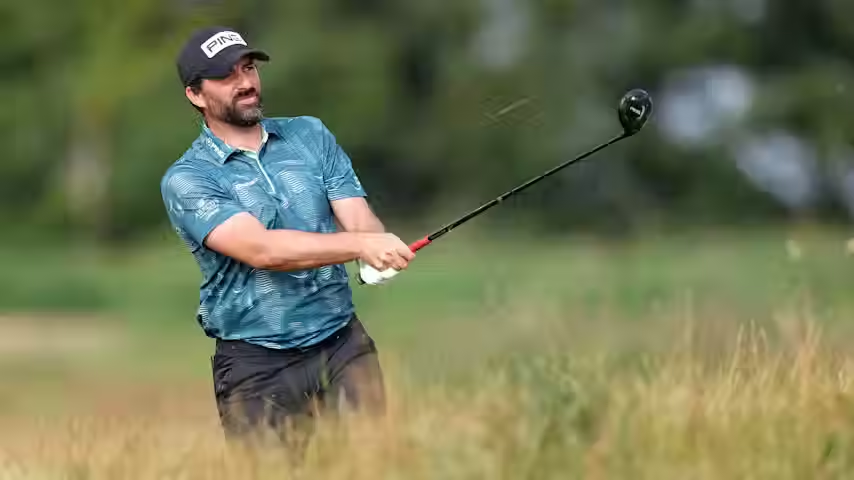
$6,900 - $6,000 Price Range: Karl Vilips ($6,800)
Karl Vilips rounds out the DFS tiers at $6,800, and this is squarely a punt play for the salary-cap-conscious builder rather than a player I'm expecting to contend. Vilips, the reigning 2025 Puerto Rico Open champion and a former Korn Ferry Tour Rookie of the Year, is still searching for his footing in his first full PGA Tour season, sitting without a top-10 in 2026 and ranked 124th in the FedExCup standings entering this week.
His results this summer have been unremarkable, with a missed cut at the Genesis Scottish Open and starts at both the John Deere Classic and ISCO Championship that didn't produce much traction, though his best finish of the season, a T13 at the Zurich Classic of New Orleans at 25 under, shows the talent is real when it comes together. Vilips' off-the-tee and approach numbers have both ranked outside the top 100 on tour this season, which is the primary reason he's priced this low.
The redeeming quality in his game has been his putter, which has graded out well above tour average most of the year, giving him a puncher's chance to scramble his way to a respectable finish even on weeks when the ball-striking isn't cooperating. At this salary, Vilips is best viewed as pure salary relief to free up cap space for the top of your lineup, a GPP dart-throw rather than a legitimate value target, and I wouldn't lean on him in cash-game builds this week.
2026 PGA Tour Strokes Gained Rankings:
Total: 107th
Off-the-Tee: 146th
Approach: 95th
Around the Green: 105th
Putting: 21st

Gambling Disclaimer
All content in this article, including but not limited to outright betting selections, daily fantasy sports recommendations, odds references, and any related commentary, is provided for informational and entertainment purposes only. Nothing contained herein constitutes financial, investment, legal, or gambling advice of any kind, and should not be relied upon as such.
All picks, opinions, and analysis reflect the personal views of the author at the time of writing and are subject to change. There is no guarantee of results. Past performance is not indicative of future outcomes, and the author accepts no liability for any losses, financial or otherwise, incurred as a result of acting on any information contained in this article.
By reading this content, you acknowledge that sports betting and daily fantasy sports involve substantial financial risk. You should never wager or contest money that you cannot afford to lose. It is your sole responsibility to ensure that any participation in sports betting or daily fantasy sports is legal in your jurisdiction before doing so.
Out of the Rough and its contributors are not licensed gambling operators, financial advisors, or legal professionals. This content is not affiliated with, endorsed by, or sponsored by any sportsbook, daily fantasy sports platform, or gambling organization.
If you or someone you know is struggling with a gambling problem, help is available. Please contact the National Problem Gambling Helpline at 1-800-522-4700 or visit ncpgambling.org. Support is available 24/7, free, and confidential.


Comments