


2026 Rocket Classic

Introduction
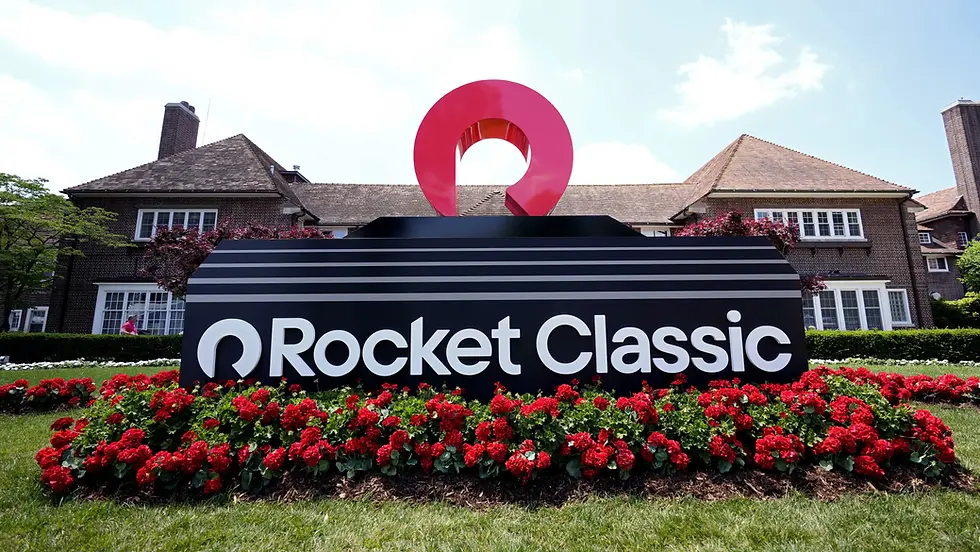
There’s a bittersweet undercurrent to this week’s trip to Detroit, because the Rocket Classic as we know it is coming to an end. Rocket Companies has confirmed it won’t renew its title sponsorship after this event, closing the book on an eight-year run that turned Detroit Golf Club into one of the more beloved stops on the summer schedule. That alone would make this week worth circling, but the Tour has also handed the field a brand new golf course to say goodbye with. Detroit Golf Club’s North Course just wrapped a $16.1 million restoration led by architect Tyler Rae, stripping away decades of tree growth and modern alterations to reveal more of Donald Ross’s original 1916 bones. The result is a longer, firmer, more strategically demanding test than the one that produced a parade of gaudy, wedge-fest winning scores over the last seven years. Add in an extremely strong field, and you have a tournament with real stakes, real sentiment and a golf course that finally looks capable of humbling this group a bit before the FedEx Cup Playoffs arrive.
Course Breakdown
Detroit Golf Club’s North Course now plays to a par of 70 and 7,328 yards, a meaningful jump from the layout players have attacked in years past, with the biggest additions coming at the 1st and 2nd holes to toughen up what had been a soft opening stretch. Ross built this course on a flat, unassuming piece of land in the University District, and the restoration leaned into that rather than fighting it, restoring the hummocks, mounding and angled drainage ditches that gave the original design its teeth. Off the tee, the challenge isn’t sheer terror so much as precision, since Rae’s rebuilt bunkering is positioned to punish players who bomb it without a plan, and the removal of decades of tree growth means misses that used to hide in the rough are now exposed to more demanding angles into the greens. This is a course that rewards a player who can control shot shape off the tee rather than one who just overpowers it.
The approach game is where this restoration really changes the character of the tournament. Ross’s perched greens are back in play, meaning shots that used to check up obediently on a receptive putting surface now need to account for more movement and firmer conditions thanks to the modernized irrigation system, which was specifically installed to give the greens and fairways a faster, firmer, more traditional Ross-style playing character. The green complexes themselves are compact and require a specific landing window, so approach play from the fairway is only half the battle. Missing in the wrong spot short-sides players against run-off areas and restored bunker faces that didn’t exist in this configuration a year ago, which should put a real premium on precise wedge play and touch around the greens rather than the spray-and-pray short game that got away with murder on the old layout.
Scoring will still be there for the players who find it, but the way to get to red numbers has changed. The two par 5s, the 592-yard 4th and the 561-yard 14th, remain legitimate birdie opportunities for the game’s longer hitters, and short par 4s like the 349-yard 8th offer a look at eagle or a simple wedge in for the shorter hitters in the field. But the course also throws four demanding par 3s at players, headlined by the brutal 246-yard 11th, and a run of long two-shotters in the 500-yard range at holes 6, 7 and 17 that will play as legitimate par 4s even for elite ball strikers. The filling in of the pond at the old 14th hole and the overall reshaping of the property removed some of the quirks that made this course play easier than its yardage suggested. Winning here now demands more than just an aggressive week with the putter. It takes a complete ball striker who can control the golf ball off the tee, attack pins with precision on firm, perched greens, and scramble effectively when the restored bunkering and short grass runoffs punish a miss.
Field Breakdown
The headline of this year’s field is Xander Schauffele, who leads a group of players committed to sending the Rocket Classic off in style. Cameron Young, Wyndham Clark, Brooks Koepka, Jordan Spieth, Patrick Cantlay, J.J. Spaun and reigning PGA Champion Aaron Rai round out an elite tier that’s noticeably deeper than what this event has historically attracted, a byproduct of the tournament’s farewell status pulling in players who might otherwise have skipped a non-signature event this late in the summer. That top tier alone gives the week a different feel than prior editions, where the presence of one or two stars was usually enough to headline the field.
Below that group sits a legitimate second tier of contenders who know this golf course and have had success on it in the past, led by defending champion Aldrich Potgieter, two-time winner Cameron Davis, and past champions Rickie Fowler and Tony Finau. Chris Gotterup, Russell Henley and Keegan Bradley add to that group as players capable of winning outright on any given week. The restored North Course is new enough that prior history here carries a bit less weight than usual, but the players who’ve shown an ability to control their ball flight and putt well on Ross-style greens should still have an edge.
The rest of the field is where the value hunting gets interesting. There’s a long list of solid mid-range plays, from Nick Taylor and Si Woo Kim to Denny McCarthy and Sungjae Im, players capable of a low week without necessarily being true 54-hole leader threats. What separates the realistic winners from the pretenders this week is going to come down to ball striking discipline more than raw scoring history, since a golf course this freshly overhauled resets a lot of the usual course-fit assumptions. Players who can control tee shots into a tighter, more demanding layout and handle firmer, perched greens should rise to the top, while the pure bombers who’ve feasted on this course’s old, softer character may find this version of Detroit Golf Club a much tougher out.
Tournament History
The Rocket Classic (known as the Rocket Mortgage Classic through 2024) has only been around since 2019, but in that short window it developed a reputation as one of the lowest-scoring, birdie-heaviest events on Tour, with every champion finishing at least 18 under par and an average winning score hovering right around 23 under. That history is about to be tested in a meaningful way, since this is the first edition played on the restored North Course, and the added length, firmer conditions and tougher green complexes could put a real dent in those gaudy 4-day totals. Whether the winning number this week looks anything like the numbers below will be one of the most interesting subplots of the tournament.
Below is a look at the past 7 champions, including their winning score relative to par:
2025 - Aldrich Potgieter (-22)
2024 - Cameron Davis (-18)
2023 - Rickie Fowler (-24)
2022 - Tony Finau (-26)
2021 - Cameron Davis (-18)
2020 - Bryson DeChambeau (-23)
2019 - Nate Lashley (-25)
Outright Betting Breakdown
Ben Griffin +3000
My model has Griffin down at 62 this week, but that ranking is baked with early-season scar tissue that doesn't reflect where his game actually is right now. He missed the cut in five of his first dozen starts and was still searching for his swing as recently as the Masters, where his off-the-tee numbers were badly negative. None of that matters anymore. The player he's become over the last two months is a completely different animal.
Griffin's form is trending in exactly the right direction. He carded a T10 at Travelers with four rounds of 67 or better, and he's gained strokes on approach in six consecutive starts, a stretch that also includes a T3 finish at the Charles Schwab Challenge, a T17 at the U.S. Open, and a T21 at the John Deere Classic.
His skillset lines up well with what the renovation is asking for. Griffin pairs elite wedge play with one of the more underrated short games on Tour, and that combination becomes more valuable now that Detroit's perched Ross greens and restored bunkering punish sloppy approaches. He's not the longest hitter in this field, but his control from 100 to 150 yards and his touch around the green should translate directly to a firmer, tighter version of this course.
2026 PGA Tour Strokes Gained Rankings:
Total: 32nd
Off-the-Tee: 97th
Approach: 117th
Around the Green: 5th
Putting: 20th

J.J. Spaun +3500
Spaun ranks 14th in my model this week, and I don't need much more than that to get interested at this number. The knock on him for years has been the putter, the part of his game that's cost him more tournaments than it's won him, but Detroit Golf Club has quietly been the one venue where that weakness disappears for Spaun. He's gained strokes on the greens in five of his six career appearances here, and in four of those, he gained more than a full stroke per round, a number that stands out given how streaky he's been on the greens everywhere else.
Spaun comes into this week having finished inside the top 35 in every trip he's made to Detroit Golf Club, a run of consistency that's rare for a player whose results elsewhere can swing wildly based on how the flat stick is working. That course-specific reliability, paired with his overall ranking inside my top 15 this week, makes him one of my favorite plays on the board at this number.
The rest of his game holds up its end of the bargain too. Spaun's approach play is elite enough to keep him in position, and this version of Detroit Golf Club, with its perched greens and firmer conditions, rewards the kind of controlled ball flight he brings off the tee. When the putter shows up for him here the way it has in the past, he has the ceiling to contend.
2026 PGA Tour Strokes Gained Rankings:
Total: 28th
Off-the-Tee: 46th
Approach: 4th
Around the Green: 56th
Putting: 130th

Hideki Matsuyama +3500
Matsuyama checks in at 22 in my model, and after what I watched from him last week, I think that number undersells where his game is at. He's got his swagger back. The short game has looked immaculate for weeks now, and last week at the 3M Open he backed that up in the most convincing way possible, finishing tied for third at 20 under with a final-round 64. That's not a fluke result. That's a player peaking at the right time.
He's no stranger to Detroit Golf Club either. Matsuyama has three top 25 finishes in his career starts here, including a tied 13th finish in the tournament's inaugural year and again last year, and this new iteration of the course should play even more into his hands than the old one did. A tighter, firmer, more demanding Ross layout rewards precision iron play and a sharp short game over pure length, and that's exactly Matsuyama's calling card.
His scrambling and around-the-green numbers have been elite for weeks, and pairing that with approach play that's shown flashes of vintage Hideki makes him one of the more well-rounded plays in this field. The one swing factor is the driver, which can wander on him, but Detroit's restored bunkering and firmer fairways matter less to a player who can bail himself out around the greens as well as he can right now. Coming off a T3 last week, I like riding this form into a golf course that fits him better than it has in years past.
2026 PGA Tour Strokes Gained Rankings:
Total: 34th
Off-the-Tee: 117th
Approach: 47th
Around the Green: 7th
Putting: 74th

Jake Knapp +4000
Knapp ranks sixth in my model this week, and I want to be upfront that his surface-level results since returning from his thumb injury look rough. Missed cuts at the Scottish Open and The Open, and a finish outside the top 50 at a no-cut Travelers, are not the kind of results that usually get a player featured in an outright section. But the model isn't reacting to the box scores. It's reacting to what's actually happening underneath them, and what happened last week at the 3M Open is exactly the signal I needed to see.
Knapp closed his week at TPC Twin Cities with a final-round 62 to finish tied for 13th at 16 under, capping a tournament where his ball striking looked like the version of Knapp we saw dominating leaderboards earlier this season before the injury derailed him. That closing round wasn't a hot putting week papering over bad ball striking either. It was a legitimate return of the aggressive, attacking game that made him one of the more dangerous players in the field through his first eight starts of the year.
His skillset makes a lot of sense for this venue. Knapp is at his best on scorable setups where he can lean on his length and take advantage of reachable par 5s, and even with the added yardage and tougher bunkering at Detroit Golf Club, this is still a course that rewards a player willing to attack. If last week's back nine was a real turning point and not a one-off, +4000 on a talent that ranks sixth in my model is a number I can't ignore.
2026 PGA Tour Strokes Gained Rankings:
Total: 14th
Off-the-Tee: 64th
Approach: 15th
Around the Green: 125th
Putting: 6th

My outright card is built around a minimum 10x return on my unit. In practice, that means I spread one total unit across all my selections for the week, structured so that any single winner returns at least 10 units. This means I only need to hit one outright in ten tournaments to break even. It keeps me honest about the odds I'm willing to accept and prevents me from chasing value at prices that don't justify the risk.
That said, this is my system, and it works for my bankroll and my risk tolerance. Yours may look completely different, and it should. Figure out what return threshold makes sense for you, how many units you're comfortable putting at risk in a given week, and build from there. The best betting system is the one you can stick to consistently, not the one that sounds best on paper.
Gambling Disclaimer
All content in this article, including but not limited to outright betting selections, daily fantasy sports recommendations, odds references, and any related commentary, is provided for informational and entertainment purposes only. Nothing contained herein constitutes financial, investment, legal, or gambling advice of any kind, and should not be relied upon as such.
All picks, opinions, and analysis reflect the personal views of the author at the time of writing and are subject to change. There is no guarantee of results. Past performance is not indicative of future outcomes, and the author accepts no liability for any losses, financial or otherwise, incurred as a result of acting on any information contained in this article.
By reading this content, you acknowledge that sports betting and daily fantasy sports involve substantial financial risk. You should never wager or contest money that you cannot afford to lose. It is your sole responsibility to ensure that any participation in sports betting or daily fantasy sports is legal in your jurisdiction before doing so.
Out of the Rough and its contributors are not licensed gambling operators, financial advisors, or legal professionals. This content is not affiliated with, endorsed by, or sponsored by any sportsbook, daily fantasy sports platform, or gambling organization.
If you or someone you know is struggling with a gambling problem, help is available. Please contact the National Problem Gambling Helpline at 1-800-522-4700 or visit ncpgambling.org. Support is available 24/7, free, and confidential.


Comments