


2026 Cadillac Championship
- Jake Friedman (@THEJakeFriedman)

- Apr 27
- 28 min read
Updated: Apr 27

Introduction
It's been a decade since the PGA Tour set foot on the Blue Monster, and the game has changed in almost every conceivable way since the last time the world's best players walked these fairways in Miami. The Cadillac Championship at Trump National Doral is here, and we are getting the long-awaited return of one of professional golf's most storied stages. This is a brand-new Signature Event on the 2026 PGA Tour calendar, the fifth of eight this season, with a $20 million purse and a limited field of 72 players. The Blue Monster is back, and it is going to remind everyone exactly why it earned its name.
The backdrop to this week is as rich as it gets. Two weeks ago, Rory McIlroy successfully defended his Masters title at Augusta National, joining Jack Nicklaus, Nick Faldo, and Tiger Woods as the only players to win back-to-back green jackets, claiming his sixth major in a dramatic final round that saw Cameron Young and Justin Rose both take turns with the lead before McIlroy delivered a pair of birdies around Amen Corner to pull away. The gravity of that result is still hanging over the tour, and while McIlroy himself has confirmed he will not be competing at Doral this week, the storylines here are still compelling. Scottie Scheffler, fresh off a runner-up at Augusta and a runner-up to Matt Fitzpatrick at the RBC Heritage, returns as the world number one and the man everyone needs to beat. Scheffler without McIlroy still draws one of the strongest collections of players you will find at any event outside of a major.
What makes this week analytically special beyond the field quality is the course itself. Doral is wide-open, water-laden, power-and-shape golf on a grand scale. Gil Hanse's 2014 renovation restored the course to something close to Dick Wilson's original 1962 vision while adding modern bite in all the right places, and with the PGA Tour setting the ball flight at 7,739 yards, this is going to be a test of ball-striking aggression and course management under pressure.
Course Breakdown
Trump National Doral's Blue Monster is a par-72 layout that will play approximately 7,739 yards for the 2026 Cadillac Championship, making it one of the longer tests on the entire Signature Event calendar. Originally designed by Dick Wilson in 1962, the course has undergone several renovations across the decades, with Gil Hanse's comprehensive 2014 redesign widely regarded as the most successful restoration of Wilson's original intentions. Where some prior renovations softened the course and moved it away from its core identity, Hanse brought back the strategic complexity that made the Blue Monster legendary, creating diagonal bunkering that forces shape off the tee, excavating new water hazards on several holes to increase penalty for poor decision-making, and restoring the greens to their original larger sizes while maintaining the undulation and slope that makes putting here a genuine test. The result is a course that rewards intelligence and commitment in equal measure, one that has been compared favorably to the best public-access layouts in the country.
The fairways here are wide, but that is not an invitation to bomb it down the middle and flip a wedge. Wilson and Hanse built this course with diagonal bunkers positioned to punish players who default to a generic tee shot, and the angles into the greens are locked on the side of the fairway you attack from. The wrong side of the fairway at Doral does not mean a blocked-out approach, it means a much harder angle into a green that is already defended by water, bunkers, or both. Distance matters here. The par-4s on this course are long and uncompromising, several of them playing close to or beyond 470 yards from the back tees, and there are genuinely demanding par-5s where the ability to get home in two with a long iron or fairway wood separates birdies from routine pars. Players who can bomb it long and keep it in the correct quadrant of the fairway are going to have an advantage here.
Water is the defining visual element of the Blue Monster, and it is not just decorative. Wilson originally threaded water hazards through twelve of the eighteen holes, and Hanse's renovation added two new lakes on the par-3 15th and the drivable par-4 16th to sharpen the finish. The result is a course where the fear of the water is almost omnipresent from tee to green. Approach shots that miss short of greens or to the wrong side frequently kick into water. Tee shots that venture left or right of the intended landing zone on multiple holes find themselves in or near a hazard. The mental weight of that constant proximity to penalty is one of the things that makes Doral uniquely demanding, and it is why the course has historically produced so many late-tournament collapses. Players who can manage their aggression, commit to their targets with full conviction, and absorb the inevitable close call without letting it spiral into a mental crisis are the ones who close here on Sunday afternoon.
The par-3s at Doral are tournament-defining holes. The 9th plays across water the entire right side of the hole to a green that is exposed to the wind, requiring precise club selection and commitment from tee to pin. The 15th, which Hanse transformed into an island green experience following the renovation, is one of the most terrifying short iron shots on the PGA Tour, a hole where the wind swirls, the green is exposed on nearly all sides, and the only safe miss is to a narrow bailout area short and right. Club selection on that hole in a South Florida wind is genuinely one of the hardest decisions players will face all week. And then there is the closing stretch, which is where Doral earns its reputation most completely.
The 16th, now a drivable par-4 measuring around 280 yards, is one of Hanse's most dramatic alterations to the original layout. Water runs the entire left side of the hole from tee to green, requiring either a full commitment carry over the lake to go for the green or a precise layup to the right of a waste bunker complex, with an awkward pitch remaining. It is a hole that absolutely will produce eagle attempts, birdies, pars, and doubles in equal measure across the field, and the decision players make on the 16th tee will be dictated entirely by their position on the leaderboard. The 17th is a par-4 of around 430 yards that bends to the right, and it sets up the most famous hole in Florida golf.
The 18th at Doral is a par-4 measuring 473 yards with water running the entire length of the left side from tee to green. It is a narrow driving corridor with the green set along the same lake, and the approach demands a precise shot into a putting surface that is guarded by water short and left and bunkers long. The green itself slopes toward the water, meaning aggressive pin-seeking comes with real cost on the wrong side. It is the kind of hole that has ended championship dreams and created tournament legends with equal regularity for six decades, and the reason it has earned its status as one of the top 100 holes in the world is precisely because it delivers on its promise every single time. Playing the 18th under pressure at Doral is a genuine examination of nerve, and whoever lifts the trophy on Sunday evening will have passed it.
In terms of green surfaces, Bermuda grass is the surface throughout, both on the fairways and the greens. Bermuda greens create more grain than players see on bentgrass, and reading that grain correctly, particularly late in the day when it is most pronounced, is a skill that separates good putters from elite ones at Doral. The greens at Doral are larger than those at Harbour Town, giving approach players slightly more margin, but the undulation and slope, combined with the grain of the Bermuda surface, still makes putting a significant differentiator across 72 holes. Wind in Miami at the end of April is also a meaningful factor, with prevailing easterly and southeasterly breezes capable of turning a long par-4 into an even longer exercise in course management. When the wind is up at Doral, the finishing stretch from 15 through 18 becomes one of the most demanding passages in professional golf.
The bottom line on the Blue Monster is this: the winner here is going to be long off the tee, accurate enough to find the correct angles, decisive on approach shots that demand commitment over caution, mentally resilient around the water, and sharp enough on Bermuda greens to capitalize on the birdie opportunities that the par-5s and the short par-4 16th present. Power and precision, aggression and nerve, this is a course that demands both ends of the spectrum, which is exactly what makes it one of the most compelling tests on the entire PGA Tour schedule.
Early Weather Forecast
Thursday: Opening day at Trump National Doral sets up as the cleanest scoring window of the week. Current data points to mostly sunny skies with temperatures climbing from the low-to-mid 70s in the morning into the mid-to-upper 80s by early afternoon, with a high around 88°F. The precipitation chance on Thursday looks to be in the 15 percent range, which is the lowest of the four competition days, suggesting both waves should get a relatively fair look at the course. Winds are expected out of the east-northeast at 10 to 15 mph, which will be manageable but enough to influence club selection on the exposed par-3s, particularly the 9th and 15th, and on the finishing stretch. Morning tee times may benefit from slightly calmer conditions before the sea breeze builds through the afternoon, but the overall picture for Thursday is favorable, and scoring should reflect that. Don't be surprised if the early leaderboard features some aggressive numbers from players who take advantage of the calm start before the wind firms up later in the day.
Friday: Friday introduces the first real weather complexity of the week. The extended forecast is pointing toward mostly sunny conditions with a lower-to-moderate precipitation chance, potentially in the 20 to 30 percent range, with temperatures again reaching the mid-to-upper 80s. The easterly breeze is expected to continue at 10 to 15 mph, with gusts potentially approaching 25 to 30 mph at peak, which would make several of the longer par-4s genuinely punishing for the afternoon wave in particular. The 7th hole, a 472-yard par-4 with water running the right side of the hole and sand dominating the entire left approach to the green, becomes a significantly different challenge when the breeze is up versus calm morning conditions. If the wind builds as currently projected, Friday afternoon could be the most demanding session of the week from a pure scoring standpoint, and any large separation in the draw between morning and afternoon tee times will be worth factoring into your DFS construction heading into the weekend.
Saturday: Moving day currently looks to be warm and partly sunny, with temperatures in the mid-to-upper 80s and wind conditions holding steady from the east-northeast. There is some uncertainty in the extended forecast for Saturday at this range, with sources showing a modest precipitation chance of around 15 to 20 percent, meaning the round should be largely playable without significant interruption. The bigger factor on Saturday is likely to be the accumulated fatigue of the course setup rather than the weather itself. The Blue Monster's water hazards and demanding par-4s tend to extract a toll through 36 holes, and Saturday is when the scoring separation between the elite ball-strikers and the field typically crystallizes. The 16th and 18th will be watching players for the first time under genuine leaderboard pressure, and wind direction shifting even slightly can completely change how those holes play. Keep an eye on the direction of the breeze Saturday afternoon, as the closing stretch into the prevailing wind is a fundamentally different examination than the same holes played downwind.
Sunday: Championship Sunday at Doral is shaping up to be the most dramatic weather picture of the week. Current extended forecasts are pointing toward partly sunny conditions with temperatures in the low-to-mid 80s and wind coming out of the east-northeast at 10 to 15 mph, potentially gusting higher. There is still meaningful uncertainty this far out, with some models suggesting a small precipitation chance in the 15 to 20 percent range for Sunday afternoon. The key variable will be whether the wind firms up or backs off as the final round progresses, because the 15th through 18th stretch at Doral plays almost entirely differently depending on wind direction. If players are closing into a headwind, the 18th becomes one of the most psychologically brutal finishers in the sport at close to a 3-iron or hybrid for a lay-back second shot approach. If the wind is down, aggressive players will be attacking the flag. Whatever the conditions, one thing is certain: Sunday afternoon at Doral on the 18th tee is going to be must-watch golf. That hole always delivers.
Field Breakdown
Rory McIlroy, Xander Schauffele, Matt Fitzpatrick, Ludvig Åberg, and Robert MacIntyre are all absent, which means five of the world's top fifteen have opted off this week. That is a legitimate story, and the scheduling awkwardness of three Signature Events crammed between the Masters and the PGA Championship is a real structural problem the Tour is going to have to address. But I am not going to write this field breakdown in the shadow of who is missing, because who is here is genuinely outstanding, and the Blue Monster does not give out participation trophies regardless of how much star power shows up. This is still one of the strongest fields assembled all season, and the course is going to filter it down to a very specific kind of winner.
At the top, the conversation starts and nearly ends with Scottie Scheffler. The world number one has been as dominant as any player in the sport through the first months of 2026, arriving at Doral off a Masters runner-up and a runner-up at Hilton Head where Fitzpatrick edged him in a playoff. The one thing I keep coming back to with Scheffler is that his tee-to-green profile, which is already elite at every stop on the Tour, actually fits particularly well at Doral. He is long, he shapes the ball both ways, and his iron play from 150 to 200 yards, the range the longer par-4s at Doral will demand on approach shots, is as good as anyone in the world. He is the clear betting favorite, and the only legitimate case against him is that the Bermuda putting surfaces at Doral have occasionally given him a hiccup, and that Sunday pressure on the 18th tee is a different animal from anything the rest of his schedule has prepared him for this year.
The second tier includes Cameron Young, who arrives as The Players champion and one of the most in-form players in the world, having lost a share of the 54-hole lead at Augusta on Sunday before closing with nine straight pars and finishing second to McIlroy. The frustration of that Augusta result, combined with the energy of being the best player on Tour not named Scheffler or McIlroy right now, makes Young a very compelling candidate at a course that rewards the kind of aggressive ball-striking he brings. Justin Rose is another name I cannot move off this week's legitimate contender list. The 45-year-old finished third at Augusta after taking the lead into Amen Corner and should be deeply motivated coming to a course where his history and iron-play profile translate beautifully. He has the kind of measured, strategic game that Doral rewards, and if he is putting even adequately on these Bermuda surfaces, his ceiling is a top-five or better. Collin Morikawa may be the most underappreciated name in the entire field, quietly one of the best approach players in the sport at a course that is going to put a premium on approaches from 150 to 200 yards. Tommy Fleetwood rounds out the elite second tier, his ball-striking consistency and creativity through the bag making him a legitimate threat on any course of this design caliber.
Further down the board, Jake Knapp is a name I keep coming back to. He entered the Masters ranked first on Tour in strokes gained total, turned in a strong Augusta performance, and brings the kind of consistent multi-category excellence that shows up on Bermuda putting courses. Russell Henley, fresh off a T3 at Augusta and one of the best drivers of accuracy on the Tour, fits the Doral setup better than his ranking might suggest. Sam Burns, Sahith Theegala, and Jordan Spieth all bring the ball-striking and short game creativity to make noise at a course this challenging, and Jason Day is a name worth watching as someone who has historically shown well when the water-and-pressure combination of a course like Doral demands his best. Hideki Matsuyama belongs in the conversation as well. His iron play in the 150-plus yard range is among the most precise in the world, he is comfortable on Bermuda greens, and Doral's layout suits his ball flight better than a narrow, accuracy-first course like Harbour Town.
The overall shape of this field is that the Blue Monster's demands will do the filtering that the missing names cannot. This is a course that wants length, shape, commitment, and nerve in equal doses, and players who bring all four of those elements to Trump National Doral on Thursday morning are the ones who will be standing on the 18th tee with something to gain on Sunday afternoon. That is the lens through which I am building my card this week, and the depth of legitimate candidates in this field at interesting prices makes it one of the more exciting betting puzzles of the 2026 season.
Outright Betting Breakdown
Let me preface this by noting that I used free play and boosts to get all four of these players onto my outright card this week. As always, be mindful to stay within your own unit size and overall betting budget when building your card.
Cameron Young +1500
Coming in at number two in my model this week, Cameron Young is the player I feel most confident about at the top of my outright card. The number is not going to jump off the page as a screaming value play, but when you look at where his game is right now and how well his profile maps to everything the Blue Monster demands, +1500 feels like a fair price on a player who is genuinely one of the two or three best golfers in the world at this moment. Young is long, he shapes the ball both ways, and his ability to commit to aggressive targets under pressure is exactly what Doral’s water-laden finishing stretch is going to require on Sunday afternoon.
From a recent form standpoint, Young is playing the best golf of his career. He won The Players Championship earlier this season, then turned around two weeks ago and co-led the Masters heading into Sunday before McIlroy delivered two birdies around Amen Corner to pull away. Young’s closing nine at Augusta, nine consecutive pars after a pair of early bogeys cost him the outright lead, was not the Sunday he wanted, but the ball-striking that got him there was elite. He arrives at Doral with two of the biggest results of his career in his back pocket and genuine confidence that he belongs in the final group on Sunday at any event on the schedule.
Young’s profile fits the Blue Monster in almost every meaningful way. He is one of the longest hitters on the PGA Tour, which gives him a structural advantage on Doral’s demanding par-4s and opens up the par-5s in a way that shorter players simply cannot replicate. His approach play from the 175-plus yard range that the long par-4s here will demand is well above Tour average, and his ability to shape tee shots to access the correct angles off the diagonal bunkering that Hanse built into this layout is a genuine competitive edge. The one area to watch is his putting, which has been inconsistent at times this season, he notably three-putted the par-3 sixth at Augusta on Sunday at a critical moment, and Bermuda greens can be unforgiving when the putter goes cold. If the flat stick cooperates this week, his ceiling here is as high as anyone in the field.
I don’t need much convincing on this one. Young is the hottest player in the world not named Scheffler or McIlroy, the course fits his power-and-shape profile beautifully, and +1500 on the second-ranked player in my model at a $20 million Signature Event is a number I’m comfortable anchoring my card around.
2026 PGA Tour Strokes Gained Rankings:
Total: 9th
Off-the-Tee: 10th
Approach: 18th
Around the Green: 50th
Putting: 68th

Chris Gotterup +3400
Coming in at number three in my model this week, Chris Gotterup is the pick on this card that I am most excited to talk about. The number feels genuinely mispriced for a player whose raw ball-striking profile is as well-suited to Doral’s demands as almost anyone in the field, and at +3400 the value embedded here is real. Gotterup is one of the longest hitters on the PGA Tour, he generates elite carry distances off the tee, and at a course where the par-4s routinely play north of 450 yards and the par-5s reward players who can get home in two, that length is a structural advantage that does not show up in the odds.
From a recent form standpoint, Gotterup has had a season of real positives mixed with some inconsistency that has kept his public profile lower than his underlying numbers might suggest. He has shown the ability to go low when the ball-striking is clicking, and the stretches of elite iron play he has produced this season speak directly to the approach demands the Blue Monster will present all week. The Masters was not his week, but Augusta’s bentgrass greens and the specific shotmaking demands of that layout are a fundamentally different test from what he will face at Doral, and it would be a mistake to read too much into one performance at a venue that does not suit every elite ball-striker. He arrives at Doral with something to prove and a game that fits the course.
Gotterup’s profile maps well to what the Blue Monster rewards. The diagonal bunkering Hanse built into this layout specifically punishes players who cannot shape the ball off the tee, and Gotterup has the shot-making range to attack from the correct angles rather than defaulting to a safe, centerfield approach that leaves difficult angles into these demanding greens. His iron play from distance is the primary reason he is this high in my model, and at a course where approach play is the primary scoring differentiator across 72 holes, a player who can flush long irons at the flag on Doral’s par-4s has a clear path to the top of the leaderboard. The short game and putting are the legitimate questions here, if those hold up on the Bermuda surfaces, the ceiling is substantial.
At +3400, I do not need Gotterup to be a lock. I need him to have a realistic path to contention, and his ball-striking profile gives him exactly that. This is a number I am happy to have on my card.
2026 PGA Tour Strokes Gained Rankings:
Total: 14th
Off-the-Tee: 8th
Approach: 31st
Around the Green: 56th
Putting: 71st
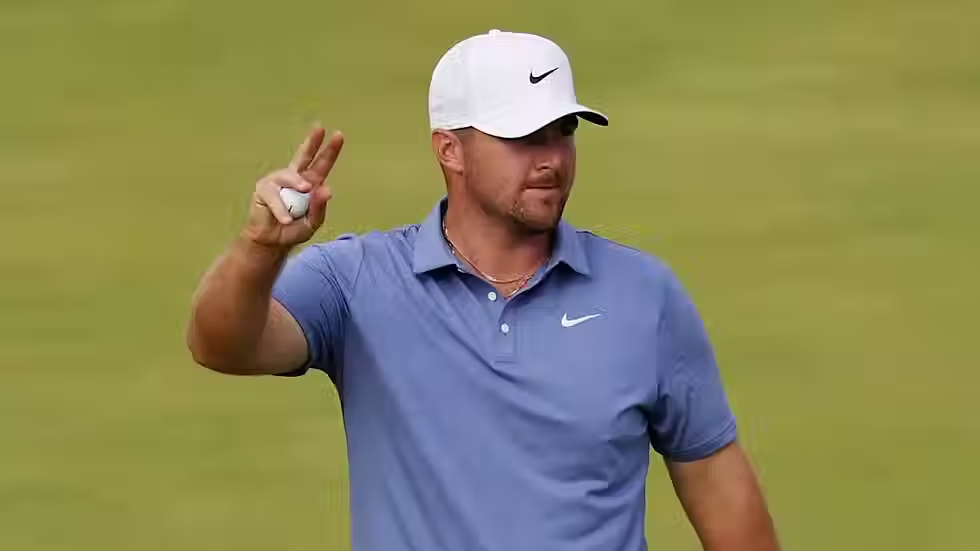
Jake Knapp +3600
Coming in at number five in my model this week, Jake Knapp is the selection on this card that feels most undervalued relative to where his game actually is right now. Earlier this season, Knapp was ranked first on the entire PGA Tour in strokes gained total, not top ten, not top five, first, and while the broader golf public has slowly started to take notice, the market has not fully caught up to what his numbers are telling us. At +3600 on a player of this caliber in a no-cut Signature Event, the expected value here is difficult to ignore.
Knapp’s 2026 season has been a genuine breakout. He has rattled off multiple top-ten finishes across a range of course types and field qualities, demonstrating that the production is real and not a product of a soft schedule or a single hot week. Most importantly for this preview, he turned in a strong performance at the Masters, a course that is famously unforgiving of technical weaknesses, which tells you that his game is not merely a statistics story but a legitimate ball-striking and scoring package that holds up against elite fields on demanding layouts. His putting has been the engine of this run, ranking among the best on Tour this season, and Bermuda greens at Doral set up very well for a player who has been making everything in sight.
Doral rewards long, aggressive ball-strikers who can putt on Bermuda surfaces and avoid the big number in the water. That is a precise description of what Knapp has been doing all season. At +3600 with the number one strokes gained total ranking earlier this year and a putting profile that fits these greens, he has more than earned his place on this card.
The floor here is lower than Cameron Young given the course history question, but at more than double the odds, the value more than compensates. I’m on Knapp this week.
2026 PGA Tour Strokes Gained Rankings:
Total: 8th
Off-the-Tee: 54th
Approach: 27th
Around the Green: 75th
Putting: 7th

Gary Woodland +8000
Coming in at number seven in my model this week, Gary Woodland is the long shot on this card, and I mean that in the best possible way. At +8000 there is real embedded value on a player whose physical profile fits the Blue Monster as well as almost anyone in the field, and whose game, when it is clicking, is absolutely capable of competing at a Signature Event level. Woodland is one of the longest hitters on the PGA Tour, he has a powerful, aggressive ball-striking style that suits a course rewarding distance and shape, and he has demonstrated across his career that he can win when the biggest tests demand his best. The 2019 U.S. Open at Pebble Beach is not a small thing on his resume.
I won’t sugarcoat the 2026 season context, Woodland is not coming in off a string of top tens, and his results this year have been inconsistent enough that the market has priced him accordingly. That inconsistency is the primary reason the number is this long, and it is a legitimate concern I am not going to wave away. What I am looking for at this price is a player who has a realistic path to contention if the best version of his game shows up, and Woodland absolutely does. His length off the tee gives him one of the biggest structural advantages available at Doral’s long par-4s, and in a no-cut format where he is guaranteed all four rounds regardless of what happens on Thursday, a slow start does not eliminate him the way it would in a standard stroke-play event. One good weekend on Bermuda greens he is comfortable on, and this is a different conversation entirely.
The Doral setup specifically favors a player of Woodland’s physical gifts. The par-5s are reachable for him in ways they are not for shorter hitters, the long par-4s become medium iron approaches rather than the hybrid or long iron shots the rest of the field is dealing with, and the aggressive line on the drivable 16th is a genuine birdie or eagle look for a player who can carry it 300-plus yards over the water. The short game and putting remain the swing variables at any price, and if those are not sharp this week, the ceiling gets capped quickly. But at +8000 in a field missing McIlroy, Schauffele, Fitzpatrick, and Åberg, the realistic contender pool is narrower than the world rankings suggest, and Woodland’s power profile gives him a legitimate path.
At this number, I am taking a shot. The expected value on a player of his caliber and course fit at +8000 is too good to leave on the table.
2026 PGA Tour Strokes Gained Rankings:
Total: 30th
Off-the-Tee: 13th
Approach: 59th
Around the Green: 154th
Putting: 30th

My outright card is built around a simple target: a minimum 10x return on my unit. In practice, that means I spread one total unit across all my selections for the week, structured so that any single winner returns at least 10 units. This means I only need to hit one outright in ten tournaments to break even. It keeps me honest about the odds I'm willing to accept and prevents me from chasing value at prices that don't justify the risk.
That said, this is my system, and it works for my bankroll and my risk tolerance. Yours may look completely different, and it should. Figure out what return threshold makes sense for you, how many units you're comfortable putting at risk in a given week, and build from there. The best betting system is the one you can stick to consistently, not the one that sounds best on paper.
Daily Fantasy Sports Breakdown
$10,000+ Price Range: Cameron Young ($10,200)
Cameron Young at $10,200 is the player I want to anchor my lineups around this week, and the case starts with course fit. The Blue Monster is built for a player of his profile, long off the tee, aggressive by nature, capable of shaping the ball to access the angles that Hanse's diagonal bunkering demands. At a course where the par-4s routinely play north of 450 yards and the par-5s reward players who can get home in two with a long iron or fairway wood, Young's length is not just a nice-to-have attribute, it is a structural advantage that will show up in his scoring opportunities every single round. He is one of the few players in this field who can turn the Blue Monster's most demanding holes into genuine birdie looks rather than par grinds.
Young arrives at Doral as arguably the hottest player in the world. He won The Players Championship earlier this season, then co-led the Masters heading into Sunday before McIlroy's back-nine birdies ended his run at a second major result. The ball-striking that powered both of those weeks is not something that evaporates between tournaments, and a player who can hang with McIlroy at Augusta on the final day is more than capable of going low on a course that suits his game even better than Augusta does. His iron play from distance, the exact range Doral's long par-4s will demand on approach, is well above Tour average, and when the putter gets hot on these Bermuda surfaces, which it absolutely can, his upside is as high as anyone in the field at any salary.
From a DFS construction standpoint, Young at $10,200 is a core cash game piece and a legitimate GPP anchor. His ownership will be elevated given his recent results and name recognition, likely landing in the 25 to 35 percent range in large-field tournaments, which does limit some of the contrarian upside. In cash games that ownership question matters far less, and I would be comfortable building around him as the foundation of a balanced lineup. The floor here is genuinely strong given the no-cut format and his current form, he is not going to sleepwalk through four rounds at a $20 million Signature Event right now. The ceiling, if the putter cooperates, is a tournament-winning performance.
The one honest concern is the putting. He three-putted a critical par-3 at Augusta on Sunday at the worst possible moment, and cold Bermuda putting has capped his ceiling before at key points this season. But the distance advantage, the iron-play upside, and the current form trajectory make him the easiest top-salary play on the board this week. I'm anchoring lineups with Young and building outward from there.
2026 PGA Tour Strokes Gained Rankings:
Total: 9th
Off-the-Tee: 10th
Approach: 18th
Around the Green: 50th
Putting: 68th

$9,900–$9,000 Price Range: Hideki Matsuyama ($9,000)
Hideki Matsuyama at $9,000 is one of the most compelling salary-for-profile plays on the entire board this week. The Blue Monster's demands, distance off the tee, precise long iron play into large but well-defended greens, and putting on Bermuda, map almost perfectly to the strengths Matsuyama has built his career around, and at a salary that sits at the bottom of the premium tier, the value window here is real. He is not going to generate the excitement of a trending name or a recent breakthrough, but when you are building DFS lineups around course fit and underlying skill profile, Matsuyama belongs near the top of the conversation at this price.
The distance angle is the starting point. Matsuyama is longer off the tee than his reputation sometimes suggests, and at Doral specifically, that length opens up the par-5s and turns the demanding par-4s into mid-iron approach opportunities rather than the long iron or hybrid shots the shorter hitters in this field are dealing with. His iron play from 150 to 200 yards is among the most precise in the world on his best weeks, and spiking with the irons is the primary way to separate yourself from the field at a course where approach play is the main scoring differentiator. When Matsuyama is hitting his irons the way he is capable of, he generates the kind of proximity numbers that translate directly to birdie opportunities at this level. Add a hot week on the Bermuda greens, where he has historically performed well, and the upside here is a legitimate top-five or better.
From a DFS construction standpoint, Matsuyama at $9,000 is an interesting pivot from the more obvious premium names in this price tier. His ownership will likely be moderate, he is a recognizable name but not one driving heavy public action right now, which creates a genuine differentiation opportunity in large-field GPP tournaments. In cash games, his course fit and the consistency of his iron-play profile give him a reliable enough floor for the no-cut format. The primary concern is that his results this season have been inconsistent enough that you are taking on some variance relative to a player in hotter form. But at $9,000 on a course that fits his strengths, and with the upside of a week where his irons spike and the putter catches fire on Bermuda, Matsuyama is a play I want in both formats.
The honest risk is the inconsistency. He has mixed strong ball-striking weeks with results that do not reflect the underlying quality of his game, and at a salary of $9,000 in a loaded field, you need him to deliver. When he does, the ceiling is real. At this price and this course, I'm comfortable taking that on.
2026 PGA Tour Strokes Gained Rankings:
Total: 16th
Off-the-Tee: 107th
Approach: 14th
Around the Green: 13th
Putting: 44th

$8,900–$8,000 Price Range: Jacob Bridgeman ($8,300)
Jacob Bridgeman at $8,300 is the play in this tier that I am most excited about from a pure upside standpoint. The 24-year-old has been one of the genuine breakout stories of the 2026 season, winning earlier this year at the Genesis Invitational, where he edged Rory McIlroy by a shot, and demonstrating across his starts this season that his combination of length, iron-play upside, and putting ability on various surfaces gives him the complete profile needed to compete in elite fields. At a salary that reflects his inconsistency more than his ceiling, Bridgeman is the kind of play that can blow up a GPP lineup in the best possible way if the week clicks.
The course fit argument here starts off the tee. Bridgeman is genuinely long, the kind of distance producer who can turn the Blue Monster's most demanding par-4s into short iron approaches and access the par-5s in two with room to spare. That length becomes even more valuable at Doral than at most Tour stops because the course's architecture rewards players who can take the aggressive line off Hanse's diagonal bunkers, and Bridgeman has the ball speed to execute those lines consistently. When his irons spike, and they absolutely can at this level, as his Genesis win demonstrated, he generates the kind of approach proximity that leads to low scoring on a course where birdie-making on the greens is the primary separation mechanism. Add a hot putter on Bermuda, which he has shown the ability to produce, and the ceiling in this price tier is as high as anyone on the board.
In GPP tournaments, Bridgeman at $8,300 is one of the most interesting roster construction pieces available this week. He will carry moderate ownership, enough that he is not a true contrarian play but not so heavily owned that the upside is diluted, which puts him in an ideal leverage spot for large-field tournaments. In cash games, the variance in his game relative to more established performers at this salary is a real consideration. He has the weeks where it all clicks and the weeks where the inconsistency that comes with a young player's developing game shows up at the wrong time. The no-cut format removes the biggest floor risk, but cash game players who want a safer outcome might prefer a proven commodity at a similar salary.
For GPP tournaments this week, Bridgeman is one of my favorite plays on the board. The combination of elite length, iron-play upside, a recent Tour win against a major-quality field, and a salary that has not yet fully caught up to his ceiling makes him a compelling centerpiece for tournament rosters.
2026 PGA Tour Strokes Gained Rankings:
Total: 4th
Off-the-Tee: 51st
Approach: 20th
Around the Green: 118th
Putting: 1st

$7,900–$7,000 Price Range: Sam Stevens ($7,300)
Sam Stevens at $7,300 is exactly the type of play that makes DFS interesting at this price tier, a player whose salary reflects a modest public profile while the underlying numbers and physical attributes tell a different story. Stevens is one of the longer hitters on the PGA Tour, a genuine distance asset at a course where that length translates directly into scoring opportunities on the par-5s and the longer par-4s. At $7,300 in a no-cut Signature Event, you are getting a player whose tee-to-green upside is meaningfully above what the salary implies, and in a week where the narrative centers on distance, iron-play spikes, and hot putting, Stevens fits the profile cleanly.
The distance angle is the primary reason he is here. Stevens can move the ball off the tee in a way that opens up a different version of this course than shorter hitters see. The par-5s become legitimate eagle opportunities rather than birdie-or-par decisions, the longest par-4s become mid-iron approaches rather than three-quarter long iron shots, and the drivable 16th is a genuine all-in look for a player of his length. That kind of structural scoring advantage does not require everything to go right to show up in the numbers, it is baked into the course layout and pays off over 72 holes of a no-cut event. When Stevens layers iron-play sharpness on top of that length, the upside in this price tier is as compelling as anyone you will find on the board.
From a DFS construction standpoint, Stevens at $7,300 is a GPP-first play with genuine cash game viability if you are bullish on his current form. His ownership will likely be on the lower end in large-field tournaments, which is exactly the kind of leverage position you want in a week where the top salary anchors will be heavily concentrated. The salary relief he provides relative to his upside allows you to build toward premium plays like Young or Matsuyama without sacrificing quality in the mid-range tiers. In cash games, the floor is reasonable in a no-cut format, though players who need a higher production floor might prefer a more established name at a similar price point.
The risk here is straightforward: Stevens needs the irons and the putter to show up together to reach his ceiling, and there are weeks where one or both do not cooperate. But at $7,300 with the distance profile and the GPP leverage this price creates, he is a player I want exposure to in tournament lineups this week.
2026 PGA Tour Strokes Gained Rankings:
Total: 45th
Off-the-Tee: 31st
Approach: 46th
Around the Green: 93rd
Putting: 105th

$6,900–$6,000 Price Range: Jordan Smith ($6,800)
Jordan Smith at $6,800 is the salary-efficient dart throw on this card, and at this price in a no-cut Signature Event against a field missing McIlroy, Schauffele, Fitzpatrick, and Åberg, the path to a useful DFS score is more realistic than the number implies. Smith is a big hitter, the kind of player who generates elite distance numbers when he is swinging freely, and at a course where length is a genuine competitive advantage rather than just a nice attribute, that physical profile creates scoring opportunities that a smaller ball-striker at this salary simply does not have access to. The Blue Monster rewards exactly the combination of power and iron-play upside that Smith brings on his best weeks.
Smith's 2026 season has been one of a player finding his footing at the PGA Tour level, with results that have been inconsistent but punctuated by stretches of genuinely impressive ball-striking that hint at a higher ceiling than his current salary reflects. He earned his way into this Signature Event field on merit, which means the Tour's own qualification metrics have identified him as one of the top performers available at this point in the season. That context matters at a price this low, you are not rostering a player who squeezed in on a sponsor exemption but one who belongs in this field on the basis of his 2026 results. When his irons are spiking and the putter catches fire on Bermuda, the upside from $6,800 is the kind of outcome that wins GPP tournaments outright.
From a construction standpoint, Smith at $6,800 is a pure GPP play that opens up significant salary flexibility in the rest of your lineup. The difference between $6,800 and $7,500 in this tier is enough to meaningfully upgrade another position, and in a week where the top-salary tier has a clear anchor in Young, the savings in the lower tiers compound quickly into lineup-building advantages. His ownership will be among the lowest on the board in large-field tournaments, which is exactly the contrarian leverage you want from a basement-priced play when the upside is real. In cash games, the floor is too thin to rely on, inconsistency at this salary in a competitive field is a real liability when you need reliable production across all four rounds.
The honest verdict: this is a tournament-only play with a legitimate ceiling and a thin floor. In GPP formats with the no-cut format removing the worst-case scenario, Smith at $6,800 with the distance profile and the iron-play upside to spike is exactly the kind of low-owned dart that can separate your lineup from the field on a Sunday when everything clicks.
2026 PGA Tour Strokes Gained Rankings:
Total: 43rd
Off-the-Tee: 18th
Approach: 29th
Around the Green: 132nd
Putting: 107th

Gambling Disclaimer
All content in this article, including but not limited to outright betting selections, daily fantasy sports recommendations, odds references, and any related commentary, is provided for informational and entertainment purposes only. Nothing contained herein constitutes financial, investment, legal, or gambling advice of any kind, and should not be relied upon as such.
All picks, opinions, and analysis reflect the personal views of the author at the time of writing and are subject to change. There is no guarantee of results. Past performance is not indicative of future outcomes, and the author accepts no liability for any losses, financial or otherwise, incurred as a result of acting on any information contained in this article.
By reading this content, you acknowledge that sports betting and daily fantasy sports involve substantial financial risk. You should never wager or contest money that you cannot afford to lose. It is your sole responsibility to ensure that any participation in sports betting or daily fantasy sports is legal in your jurisdiction before doing so.
Out of the Rough and its contributors are not licensed gambling operators, financial advisors, or legal professionals. This content is not affiliated with, endorsed by, or sponsored by any sportsbook, daily fantasy sports platform, or gambling organization.
If you or someone you know is struggling with a gambling problem, help is available. Please contact the National Problem Gambling Helpline at 1-800-522-4700 or visit ncpgambling.org. Support is available 24/7, free, and confidential.


Comments